On December 10, the 33rd session of the Tsinghua Software Forum invited Professor M. Tamer Özsu, Fellow of the Royal Society of Canada, Distinguished Visiting Professor at Tsinghua University, and Professor at the University of Waterloo, to deliver a lecture entitled "Beyond Storage Disaggregation: Fully Disaggregated & Heterogeneous Computing for Data Management" . The forum was held in a hybrid format. Some faculty members and students from the School of Software attended on-site, while others, along with scholars and researchers in the fields of databases and information systems from various universities, participated online.
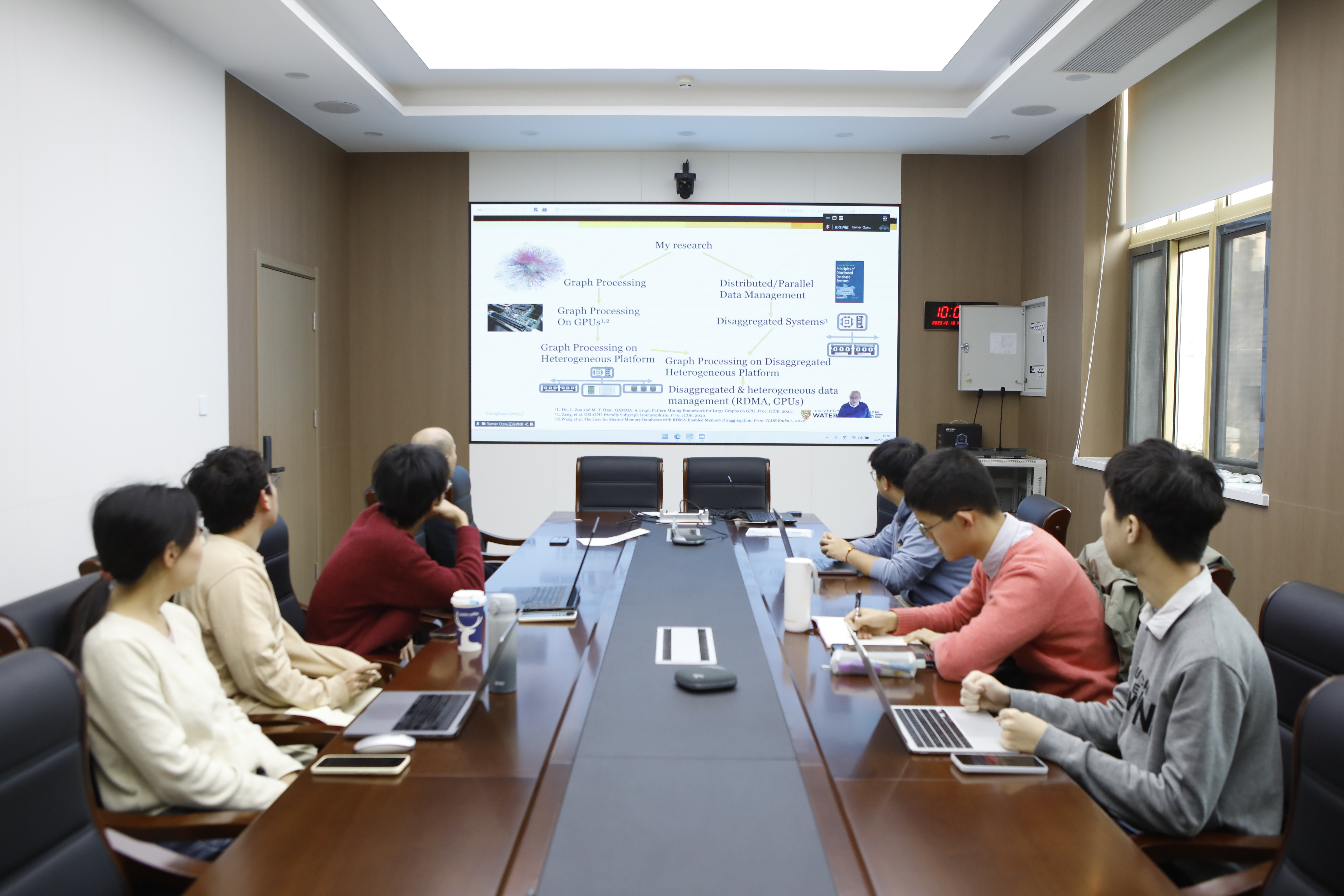
Prof. Özsu gave academic reports online
At the beginning of the lecture, Prof. Özsu introduced the concept of the Disaggregated Heterogeneous Platform, emphasizing how system components can be efficiently separated through high-speed interconnects and executed on diverse computing nodes to enhance performance and computational efficiency. He noted that the rise of big data applications and AI has introduced new computational demands—namely, massive storage capacity, intensive repeated computation, and ultra-large memory requirements. Prof. Özsu then analyzed recent technological changes. He observed that, driven by the need for elasticity, availability, and cost savings, data migration to cloud platforms has been expanding rapidly. Meanwhile, conventional hardware components such as processors, memory, and storage, have undergone substantial improvements, while new accelerators like GPUs, FPGAs, and ASICs are increasingly used to meet various application scenarios. Building on these observations, Prof. Özsu elaborated on the architecture of a fully disaggregated heterogeneous platform, advocating the separation of storage, memory, and accelerators to improve system flexibility and fault tolerance. Concluding his talk, Prof. Özsu remarked that "the environment is getting interesting", with continual hardware evolution and a vast design space driving further innovation in disaggregated architectures.
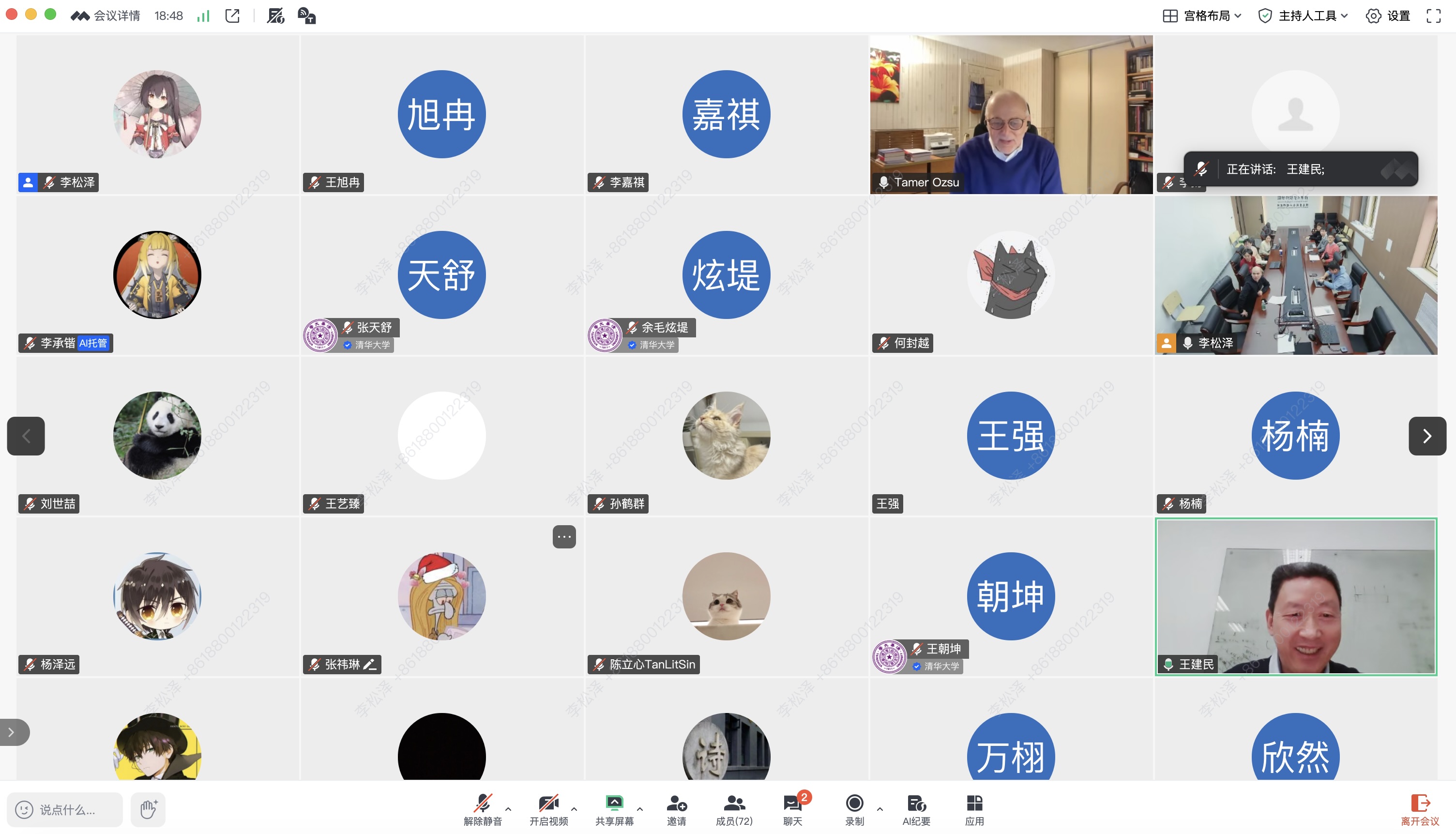
Group photo of online participants
In the Q&A session, President Jianmin Wang extended greetings and thanks to Prof. Özsu. Participants engaged with Prof. Özsu on topics such as distributed databases and operating systems, exploring the interconnections among software foundations, storage disaggregation, and heterogeneous computing. One of the attending students asked about the risk of data transmission errors in decoupled computing architectures and how the CXL protocol can reduce such errors. Prof. Özsu explained that CXL provides hardware cache consistency, allowing developers to not worry about cache management issues. However, when using RDMA, they need to consider the performance challenges brought by cache consistency. He also mentioned the related design choices and security considerations.